

Right now, in April 2026, running a capable AI platform for your entire team costs less than a few business lunches a month. That is genuinely remarkable. Five years ago, what AI can do today would have required a significant software budget and a team of specialists to maintain it.
The cheap era is real. And the question worth asking is: why?
The gap between what you pay and what it costs to provide
OpenAI 2025 as an example, but a pattern shared by every major AI provider.
What you pay
$3.7B
OpenAI revenue, Year 2025
Predictable pricing
Low monthly cost
The gap
$5B
per year, funded by investors
Priced into your future spending
Actual cost to provide
$8.7B
OpenAI compute cost, 2025
Growing with every
new user and query
Source: The Information · Wall Street Journal · OpenAI financial reporting 2025
These are not failing companies, this is deliberate market strategy to build dependency before normalising prices
The short answer is that the companies providing AI are not yet charging what it costs them to run it. OpenAI generated around $3.7 billion in revenue last year and spent nearly $8.7 billion on computing to deliver it. Anthropic spends roughly a dollar and seventy cents for every dollar it earns. These are not failing companies, they are well-funded organisations making a deliberate strategic choice. Build the habit first. Build the dependency. Compete on price now, figure out the margin later.
A simple $1 exercise to understand where the AI prices might go.
$1 – today’s subsidized price you pay, kept artificially low by investor funding.
$1.70 – real actual cost’s to deliver the service.
$5.67 – the $1.70 baseline plus typical 70%+ margin for the industry.
The healthy operation would require 467% hike in prices at this point.
To manage the potential price increase risk, stay AI provider agnostic.
This pattern is not new. We have seen it in cloud computing, in ride-sharing, in streaming. The economics eventually normalise. The companies that come out well after that normalisation are the ones who were paying attention while the prices were still low.
There is a reasonable counterargument. The cost of running AI has actually fallen dramatically, in some cases tenfold in a single year as the underlying technology improves. So perhaps cheap AI is simply the permanent state of affairs. Prices fall, stay low, and the concern disappears.
Maybe. But two things are happening simultaneously that complicate that optimism.
How AI pricing is changing
The shift away from flat subscriptions is already underway at major providers.
to 2025
Flat, predictable pricing
✓ Fixed monthly fee regardless of usage
✓ Know your AI budget twelve months ahead
✓ Same price whether used daily or rarely
✓ No surprise charges at end of month
✓ Easy to plan and compare providers
Happening now
2026 onwards
Consumption-based billing
! Pay based on how much you actually use
! Commit to monthly volume upfront
! Overages charged at full rate, no discount
! 78% of IT leaders report surprise charges
! Harder to switch once patterns are set
Anthropic moved enterprise customers to consumption billing in Q1 2026.
Source: Zylo 2026 AI Cost Report · Anthropic enterprise pricing restructure (The Information)
First, the pricing model itself is changing and not in a direction that benefits buyers. Several major providers have already moved their largest customers away from flat, predictable subscriptions toward consumption-based billing where you commit to a monthly volume upfront and pay the full rate for anything above it. According to Zylo’s 2026 AI Cost Report, 78% of IT leaders already report unexpected AI charges because of this shift. The direction of travel is clear, and it is moving toward less predictability, not more.
Second, and more importantly, the real risk is not that your current bill goes up. The real risk is that you cannot leave when you want to.
Here is what that looks like in practice.
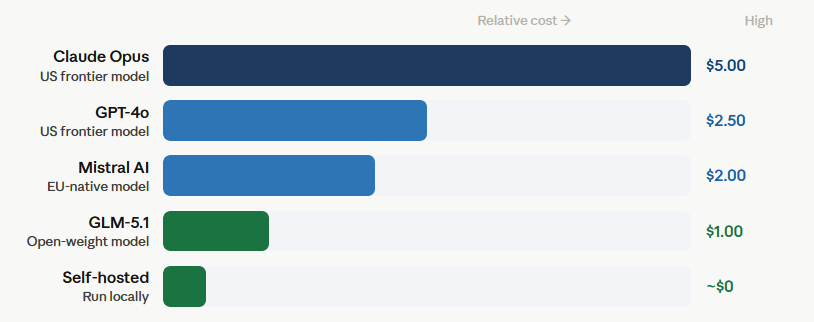
Capable AI systems already vary 10x in price
All of these handle core business tasks, but can you access the full range?
The problem
Locked into one provider: you access one row. The others don’t exist for you.
Solution
Model-agnostic platform: you choose from all rows. Switch when it makes sense.
Approximate relative pricing per unit of AI processing · April 2026
All models listed are capable of handling core business AI tasks
At this moment, capable AI systems vary in price by a factor of ten or more. A frontier model from one of the large US providers costs roughly five to ten times more than a capable European or open alternative that handles most business tasks equally well. The businesses that can access that full range, and who can move to a cheaper or better-suited option when one appears, have a structural advantage over those who cannot.
The businesses that cannot switch are the ones who built their AI directly into a single provider’s interface. Their team learned one system. Their company knowledge was configured for one platform. Their workflows were shaped around one set of behaviours. The day they want to move, because a better option emerged, because their provider changed terms, or because they simply want to try something else, they are not choosing between two options. They are choosing between staying and rebuilding.
For a ~150 employee company, switching AI providers isn’t a million-euro disaster, but it can be a temporary productivity kill. Even with a single AI owner on staff, a clean migration takes about two months of focused work. Between salary costs and the intense testing needed to ensure the new AI doesn’t break your existing workflows, you are looking at roughly €30,000 in direct costs.
For those eight weeks, your AI lead isn’t building new features or improving your product; they are stuck ‘replacing the plumbing’ not because the new provider is complicated. But because the previous one had become structurally embedded in everything built.
This risk has a specific dimension for European businesses worth naming. Regulatory shifts and geopolitical instability mean that a provider operating smoothly in your jurisdiction today may face very different conditions tomorrow. When a major US provider recently declined to release their latest model in the EU due to regulatory uncertainty, businesses that had built directly on that provider’s platform had no graceful alternative. The businesses watching that moment calmly were the ones whose underlying AI model was simply one component they could swap out, not the foundation everything rested on.
Build the platform. Rent the engine.
The layer you control compounds in value. The engine underneath can always change.
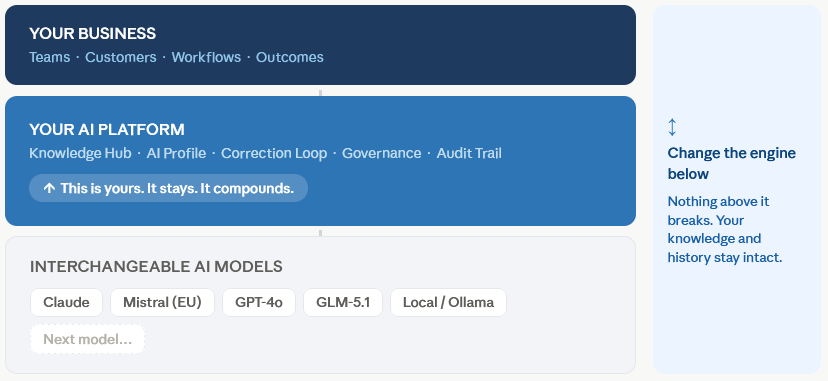
The model is the commodity. Your knowledge, voice, and governance are the moat.
When a better or cheaper engine arrives, a model-agnostic platform lets you switch in hours, not months.
Augela is built model-agnostic from the ground up. EU, US, and on-premise deployment options included
The practical answer is an architectural decision, not a procurement one. It is the difference between building your company’s AI directly on a provider’s interface, their tools, their platform, their roadmap and building it on a layer you control, that can sit above any model you choose.
The layer you control is the part that compounds in value over time: your company’s knowledge base, the AI profile that makes the system speak in your voice, the correction loop that makes it smarter as your team uses and improves it. These do not belong to any AI provider. They belong to you. The model underneath is interchangeable.
This is the principle Augela is built on – model-agnostic from the ground up, with EU, US, and on-premise deployment options, so that when a better or cheaper AI engine becomes available you change the engine, not the car. Your knowledge, your governance, your improvement history all stay intact. Other platforms are taking the same architectural approach. What matters is that whichever platform you choose, you are building on something where the model can move independently of everything above it.
The window for building this correctly is right now, while AI is affordable and the pressure to move fast has not yet become pressure to move cheaply at any cost. The businesses that will look back on 2026 as the year they got this right are the ones who used the cheap period to build something that does not depend on staying cheap.
AI is genuinely affordable today. The question is whether the AI you are building on is truly yours or whether you are renting access from someone who has not yet told you the full price.
Ready to get started?
Create an account or get in touch.
Access the complete human AI interface with transparent monthly payments or contact us to create the optimal package for your business.
Subscribe to Augela Blog